
10 Best Barefoot Running Shoes (Minimalist & Wide Toe Box Picks)


Affiliate disclaimer

Finding running shoes that truly let your feet move naturally isn’t easy. Most traditional running shoes narrow toward the toes and rely on cushioning and support, which can interfere with how your feet work when you run.
Barefoot running shoes take a different approach. With a wide toe box, zero-drop platform, and flexible sole, they allow your feet to move more freely and encourage a more natural running style. Some runners prefer extremely minimalist shoes with very thin soles, while others choose running shoes with a wide toe box and more cushioning for longer distances. If you’re just starting out, or not completely sure your feet and body are ready for thin soles, our advice is simple: begin with thicker ones and transition gradually from there.
In this guide, we share the best barefoot running shoes, along with wide toe box running shoes for runners who prefer more cushioning. We also explain how to run safely in barefoot shoes and transition without injuries.
The Barefoot Runners Who Tested These Shoes


For this guide, we worked with two experienced runners who have spent years running in barefoot shoes.
Tomaž has been running in barefoot shoes since 2018 and regularly runs 10–20 km several times per week on both roads and trails. He also participates in races such as the Ljubljana Marathon and trail events in Slovenia and abroad. Over the years, he has tested everything from ultra-thin minimalist shoes to models with slightly thicker soles.
Marko studied sports science and has spent his career working with athletes. He has been using barefoot shoes for about five years and prefers running mostly in nature on shorter distances. Because of previous tendon injuries from competitive sports, he usually chooses wide toe box running shoes with thicker soles, which still allow natural toe movement while providing more cushioning.
Together, they’ve tested a wide range of barefoot running shoes and foot-shaped running shoes to see how they perform in real conditions.
What Are Barefoot Running Shoes?
Most traditional running shoes rely on technology like thick cushioning, motion control, and arch support to stabilize the foot. Barefoot running shoes take the opposite approach. Instead of trying to control how your foot moves, they are designed to let your feet do the work they were built for.
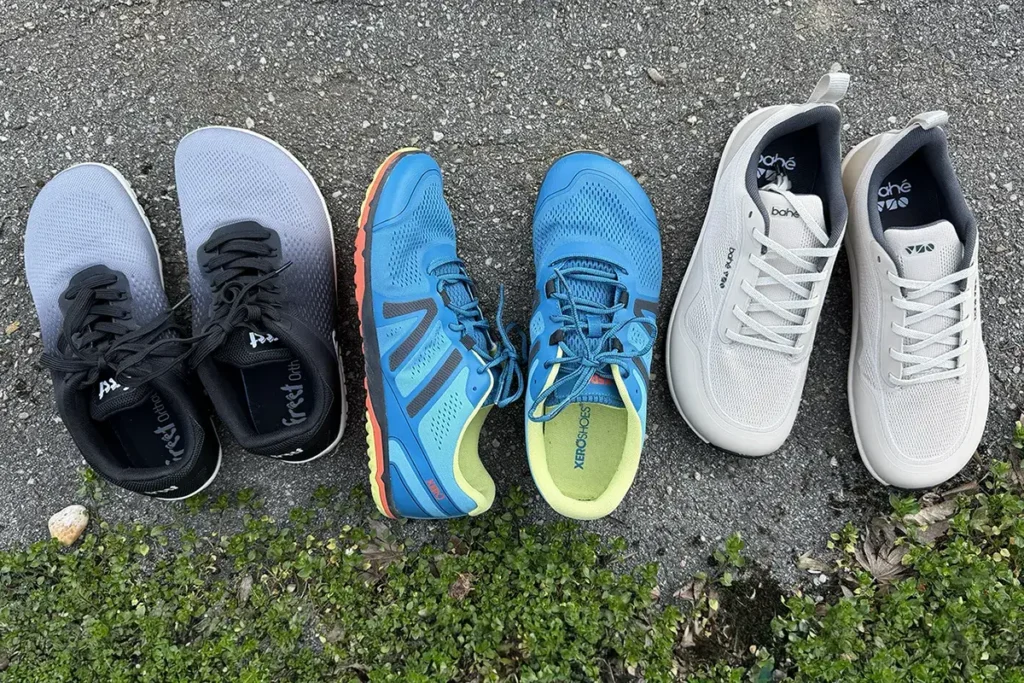
A true barefoot running shoe usually has a few key characteristics:
- Wide, foot-shaped toe box – allows the toes to spread naturally and stabilize the body while running.
- Zero-drop sole – the heel and forefoot are at the same height, supporting a more natural posture.
- Thin and flexible sole – lets the foot bend and move freely and improves ground awareness.
- No arch support – allows the foot muscles to do their natural stabilizing job.
You can read more about these principles in our guides on what are barefoot shoes, the benefits of barefoot shoes, and the differences between regular vs barefoot shoes.
That said, not every runner is ready to jump straight into the thinnest soles. One of the advantages of wide toe box running shoes is that they come in a range of sole thicknesses. Some offer very minimal ground feel, while others provide more cushioning while still giving your toes the space they need.
In this guide, we’ve included options across that spectrum so you can choose what works best for your feet, your running technique, and the terrain you run on.
Running in Barefoot Shoes: Start Slowly
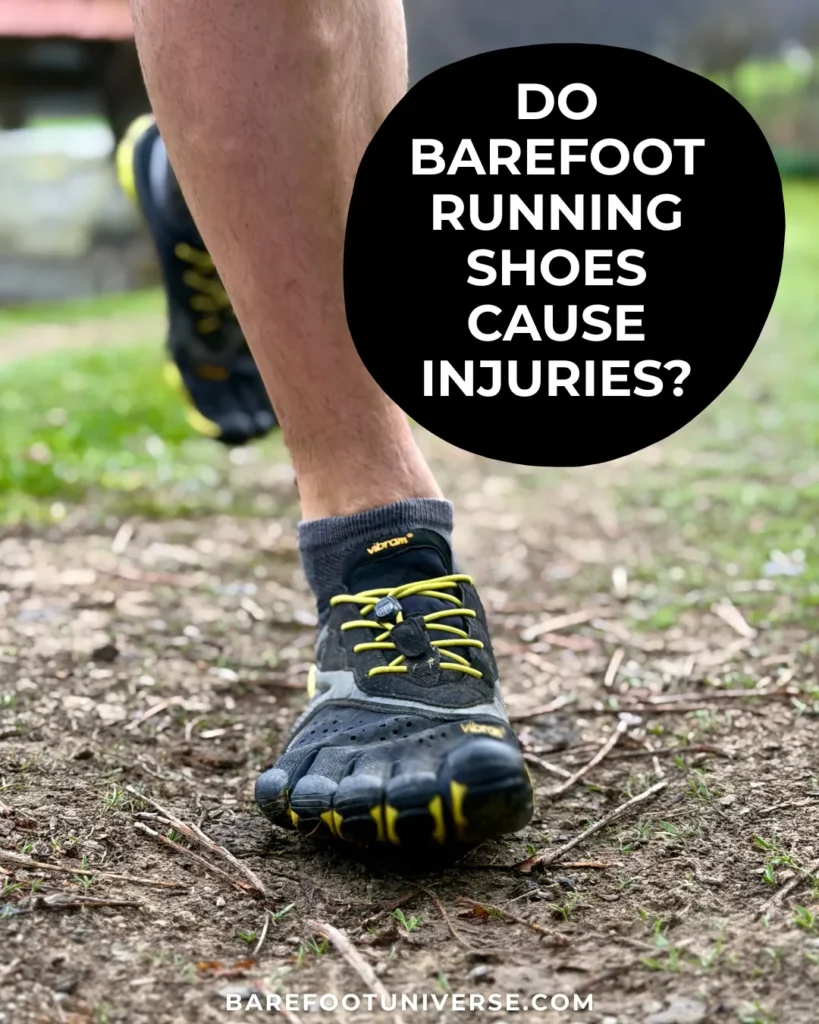
Running in barefoot shoes can feel incredibly natural, but switching too quickly can place extra stress on your feet, calves, and Achilles tendon.
If you’re new to minimalist running, it’s important to build foot strength, improve overall body alignment, and adapt gradually before running in very thin soles.
⚠️ Important: Switching to barefoot running shoes without gradually adapting your body and strengthening your feet can lead to pain or injury.
👉 Scroll down to see the models we recommend.
You can also read our tips on how to transition to barefoot running safely later in this guide.
Best Minimalist Barefoot Running Shoes
The models below are minimalist barefoot running shoes that we and our testers have personally worn and tested during real runs. They represent some of the best options if you’re looking for thin, flexible shoes that allow your feet to move naturally.
Because every foot is different, the best choice will also depend on your foot width, foot shape, and running preferences. If you’re unsure what works best for your feet, take our Foot Width Quiz to help narrow down the options before choosing a model.
If you prefer even more minimal footwear, some runners also choose barefoot running sandals, which offer maximum ground feel and freedom for the toes.
Xero Shoes


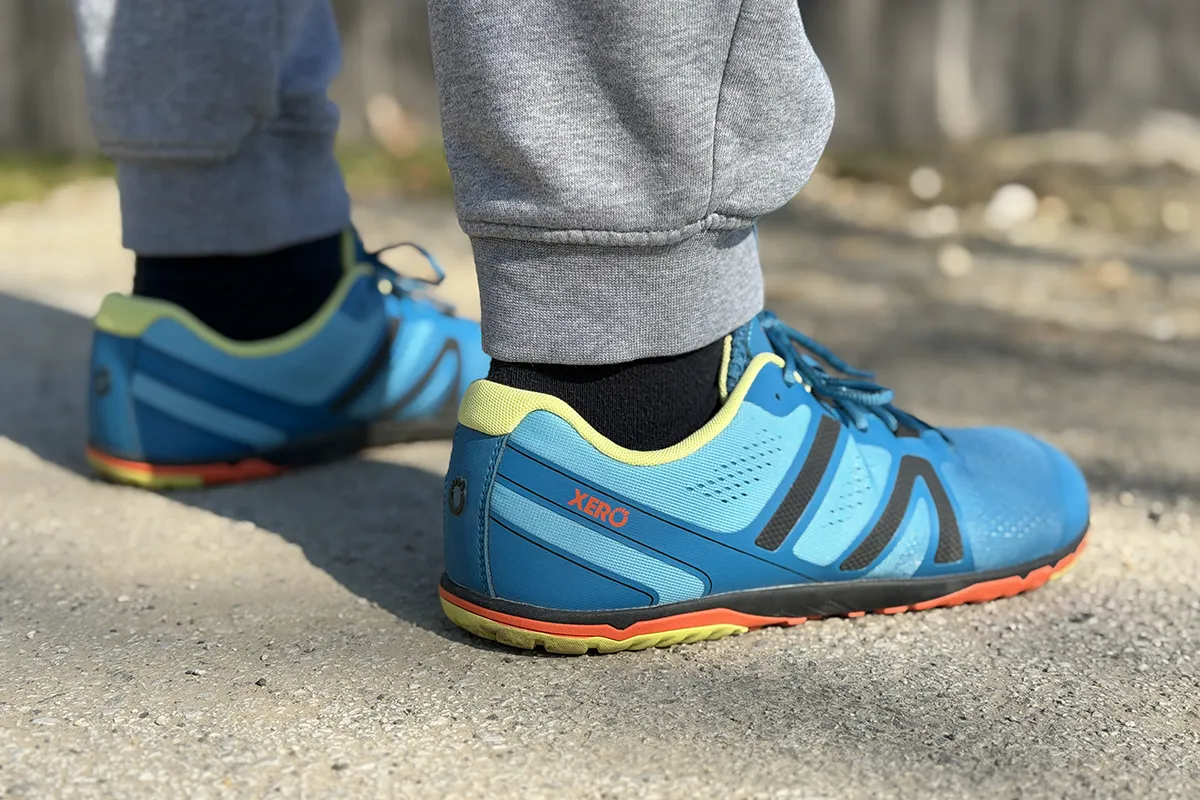
Xero Shoes were one of the first barefoot running shoes Tomaž started running in, and he still has his original pair today. At the beginning, he expected the mesh upper to tear because the material looked so light and minimal. But surprisingly, the shoes have held up very well and are still going strong after years of running.
- Fit: Best for narrow to medium-width feet. They are not the widest barefoot running shoes, but sizing up can add a bit of extra width.
- Sole: Thin and flexible with slightly more cushioning than ultra-minimal shoes, while still maintaining a strong barefoot feel.
- Best for: Runners who want minimalist running shoes with a bit more protection than the thinnest barefoot options.
Xero offers several running models. Tomaž runs in the Prio and HFS models, which have proven to be durable and comfortable for regular runs. While they do include a little more cushioning than some minimalist shoes, they are still very minimal, so a gradual transition to barefoot running is important.
Consider Before Buying:
- Not the widest toe box compared to some barefoot brands.
- Still quite minimalist, so beginners should transition gradually.
Vibram Five Fingers


Few shoes represent barefoot running as clearly as Vibram FiveFingers. With five individual toe pockets, they provide one of the closest experiences to running truly barefoot. Tomaž has been running in them for years and describes them as “almost indestructible” – durable, minimal, and surprisingly long-lasting even with regular use.
- Fit: Works best if your foot shape matches the toe pockets. Finding the right size can be tricky because each toe must sit comfortably in its own compartment.
- Sole: Extremely thin and flexible with excellent ground feel.
- Best for: Experienced barefoot runners who want the most minimal running experience.
Vibram offers several models, some with slightly more cushioning than others, but all remain highly minimalist. The individual toe pockets allow maximum toe movement and can even act as small toe separators. In my case, however, the fit was difficult to dial in. Women’s sizes pulled my toes slightly together, while men’s sizes felt too wide and pushed my pinky toe outward. If the shape matches your foot well, though, these can be fantastic running shoes.
Consider Before Buying:
- The toe-pocket design does not adapt well to every foot shape.
- The extremely thin sole is best suited for runners already adapted to barefoot running.
VIVOBAREFOOT


Use BU_15 for 15% discount
VIVOBAREFOOT Primus models are one of the most recognizable barefoot running shoes, alongside Vibram FiveFingers. Their Primus Trail is designed for trail running and offers slightly better durability and grip compared to some of VIVO’s road models.
Tomaž actually started running in the Primus Lite, but his experience with durability was not the best. After roughly 200 km of running (around 15 runs), the shoes started to fall apart, which was disappointing considering the relatively high price. The newer Primus Flow model also runs quite narrow and has a plastic upper that can feel uncomfortable for some runners, and overall we’re not big fans of that model.
- Fit: Best for narrow to medium-width feet. Men’s versions tend to be slightly wider overall and offer more volume and heel width than women’s models.
- Sole: Thin and flexible with good ground feel, but the trail outsole provides better grip for off-road running.
- Best for: Minimalist runners who want a versatile shoe that can also work well for gym training and other athletic activities.
The Primus Trail generally feels more robust than the Primus Lite and performs better on uneven terrain, though it still keeps the lightweight and minimalist feel typical of VIVOBAREFOOT shoes.
Consider Before Buying:
- Not ideal for wide feet.
- Durability may be lower with heavy running use.
- Very thin sole, so best suited for runners already adapted to minimalist footwear.
Joma


Joma is a well-known sports brand that only recently introduced barefoot-inspired models. Their barefoot lineup includes shoes like Sima for trail running and Viper for road running. We haven’t tested these running models yet, but they are worth checking if you are looking for barefoot running shoes on the more affordable side.
- Fit: Best for medium-width feet.
- Sole: Joma offers several barefoot-style soles with moderate cushioning compared to very minimalist shoes.
- Best for: Runners looking for more affordable barefoot-style sports shoes.
Marko tested the RT50 sneakers, which are not technically labeled as running shoes but can still work well for different sports activities. They come with two interchangeable insoles, one with a slight heel rise and one zero drop, allowing you to adjust the feel and cushioning. Marko found the shape comfortable with good toe space, soft materials, and no pressure points. The cushioning works well for his Achilles tendon, which can be sensitive in thinner shoes. He personally prefers using them for tennis rather than running, although they perform well for both.
Because these shoes sit in a more affordable price range, the upper can start to look worn a bit faster with regular use.
Consider Before Buying:
- Some models are slightly thicker than typical barefoot running shoes.
- The brand’s barefoot running lineup is still relatively new.
Freet


Use code BU_FREET for 10% discount
Freet is a brand many people immediately associate with outdoor activities. Their shoes are built as versatile all-purpose footwear and are often used for a wide range of activities including running, hiking, gym workouts, and everyday wear.
- Fit: One of the wider options on this list. Works best for medium and wide feet.
- Sole: Flexible minimalist soles designed for different terrains, including road and trail running. Many models also include removable insoles, allowing you to easily adjust the level of cushioning.
- Best for: Runners looking for versatile barefoot shoes that can handle multiple activities.
Freet offers several models suitable for running. Some of our favorites include Vibe, Flex, Calver, and Feldom, which are all in heavy rotation in our household. Their versatility and roomy fit make them reliable everyday barefoot shoes that work well for many different activities.
Consider Before Buying:
- Outdoor-inspired design may feel less “running-specific” than some performance models.
Softstar Shoes Megagrip PRIMAL RunAmoc


The Softstar Megagrip PRIMAL RunAmoc is a trail-focused barefoot running shoe with one of the grippiest soles in the minimalist category. The deep tread and Vibram Megagrip outsole provide excellent traction on uneven terrain, making them a strong choice for trail running.
- Fit: Available in two widths. The regular width already offers plenty of space for medium-width feet, while the wide version is one of the widest barefoot running shoes on the market and works well for extra-wide feet.
- Sole: Flexible sole with deep lugs and excellent traction, designed specifically for trail running.
- Best for: Trail runners who want maximum grip and a very roomy toe box.
The thin leather upper feels soft and high quality, but the shoe does not offer much vertical space above the toes. In my case, my toes were pressing against the leather even after sizing up one size. If you are near the upper end of the size chart or have higher toe volume, sizing up two sizes may work better.
The shoe can be laced securely, but the heel cup shape did not hug my heel perfectly, so the fit around the heel felt slightly loose for my foot.
Consider Before Buying:
- The toe box is very wide but has limited vertical space above the toes.
- The heel cup may not feel very secure for all foot shapes.
Best Wide Toe Box Running Shoes (With Cushion)
The models below are wide toe box running shoes that offer more cushioning while still allowing your toes to spread naturally. They aren’t technically barefoot shoes, but they can be a great option for runners who want a foot-shaped design with more protection from the ground.
They can also work well for runners who are new to barefoot shoes or prefer a bit more cushioning for longer runs or harder surfaces.
Altra Running


Altra is almost a synonym for wide toe box running shoes in the running community. Their shoes combine a foot-shaped design with generous cushioning, making them a popular choice for beginners and long-distance runners who want more protection while still allowing natural toe movement.
- Fit: Best for medium and wide feet. Many Altra models come in different foot shapes, and some versions are noticeably narrower.
- Sole: Thick cushioned soles that provide protection without feeling overly soft or unstable.
- Best for: Road and trail runners who want wide toe box running shoes with more cushioning.
Altra offers many models designed for different terrains, including road, trail, and waterproof options. Our top recommendations are Lone Peak and Escalante, which are built on Altra’s widest “Original FootShape” platform and offer a good balance of cushioning and responsiveness. The shoes can feel a bit stiff at first but usually soften with use. We also recommend sizing up about one size compared to your usual size.
Consider Before Buying:
- Some models come in Original and Slim fit. The Slim versions are narrower and do not provide the same wide toe box.
- The Olympus model also uses the wide platform but has significantly more cushioning and a stiffer feel than Lone Peak or Escalante.
Bahè


Use BU10 for 10% discount
Bahè are wide toe box running shoes with grounding technology, designed with a completely zero-drop platform and available in three levels of cushioning. This allows runners to choose how much protection they want while still keeping a natural foot position.
- Fit: Best for medium and wide feet. The overall shape is comfortable with slightly more volume around the instep, though the toe area sits a bit lower.
- Sole: Available in three different sole thickness options. Marko prefers the middle option, which offers a good balance between cushioning and natural ground feel.
- Best for: Trail runners who want foot-shaped running shoes with moderate cushioning.
Marko tested these shoes and found them lightweight, breathable, and comfortable for trail running. The outsole provides good grip on uneven terrain, and he had no issues with his Achilles tendon while running in them. However, the upper material showed signs of wear relatively quickly.
Consider Before Buying:
- Slightly lower vertical space above the toes.
- Upper material may wear faster with heavy use.
Joe Nimble


Joe Nimble is a German brand known for its toe freedom shoes, focusing on foot-shaped designs that allow natural toe movement. In recent years, the brand has focused heavily on wide toe box running shoes, offering models for road running, trail running, and different weather conditions.
- Fit: Best for narrow and medium-width feet. The toe box allows natural toe movement, but overall the shoes are not as wide as some other options on this list.
- Sole: Cushioned running soles that vary by model, with some offering more protection for long-distance running.
- Best for: Runners looking for durable wide toe box running shoes with cushioning.
Joe Nimble offers several running models built for different terrains and conditions. While all models provide good toe space, the level of cushioning varies depending on the shoe. Their running shoes are known for excellent build quality and durability. One thing to note is that most models include a small heel rise, so they are not completely zero drop.
Consider Before Buying:
- Most models include a slight heel rise rather than a completely flat sole.
Lems Shoes


Use BU10 for 10% off at Lems EU
Lems shoes are not strictly labeled as running shoes, but we find them to be very versatile athletic shoes that work well for running, gym workouts, and other sports. Their simple design and flexible construction make them a reliable option for everyday training.
- Fit: Best for medium and wide feet. Models from the Primal series are made on Lems’ widest last and offer generous toe space.
- Sole: Thick sole with moderate cushioning, but noticeably more flexible than some cushioned running shoes such as Altra.
- Best for: Runners looking for versatile athletic shoes they can use for multiple activities.
My personal favorites are models from the Primal series, which combine a roomy toe box with a lightweight and comfortable feel. While the sole is still relatively thick, it remains flexible enough to allow natural foot movement. They may not be designed specifically for running, but they perform well as all-purpose athletic shoes.
Consider Before Buying:
- Not specifically designed as running shoes.
Lems shoes are widely available from both US and EU retailers, making them relatively easy to find depending on your location.
Running in Barefoot Shoes: How to Transition Safely


Running in barefoot shoes changes how your body interacts with the ground. With less cushioning and support, your feet, muscles, and tendons take on a larger role in absorbing impact and stabilizing your stride.
Barefoot running itself is a very natural way of moving. The challenge is that many of us grew up wearing heavily cushioned shoes and living a lifestyle that doesn’t use our feet and lower legs as much as they were designed to. Because of this, switching to minimalist shoes can suddenly activate muscles and tissues that haven’t been working as much for years.
This becomes especially important when running, because running places much higher forces on the body and joints than walking. Your body will always try to move in the most efficient way it can with what is available to it. But if your movement pattern is not well aligned, those forces can be transferred to parts of the body that were not meant to absorb them.
That’s why the key question isn’t whether barefoot shoes are good for running. Many of them are excellent. The real question is whether your body is ready to run in the thinnest soles.
Your running technique, the terrain you run on, the distances you cover, and the strength of your feet and body should all be starting points when choosing the right shoes.
These guidelines can help your body adapt safely.
Key steps for a safe transition
- If you’re completely new to barefoot shoes, start with more cushioning.
Instead of jumping straight into ultra-thin minimalist shoes, begin with wide toe box running shoes that still offer some cushioning. This allows your toes to move naturally while giving your body more time to adapt. - Build foot strength first.
Strong and functional feet are essential for running in minimalist shoes. Wearing barefoot shoes for everyday activities and walking is one of the easiest ways to strengthen the small muscles in your feet. - Walk before you run.
Running places significantly greater stress on your body than walking. Start by wearing barefoot shoes for daily use and walks before adding running. - Work on your running technique
Highly cushioned running shoes often allow runners to land too hard and develop inefficient running mechanics. Try running barefoot for a few steps on a safe surface. Most people will naturally shorten their stride, increase cadence, and land more softly. - Increase running time gradually
Start with short runs and slowly increase your running time or distance. Giving your body time to adapt helps reduce unnecessary strain and allows you to build strength progressively. - Choose the right terrain
Hard pavement, trails, and uneven terrain all affect how your body handles impact. The surface you run on should influence both your technique and the type of shoe you choose. - Be patient with the transition
Adapting to barefoot running can take time. Gradual adaptation and listening to your body are key to avoiding injuries.
For a more detailed step-by-step guide, see our article on how to transition to barefoot shoes.
Barefoot Running Shoes: Sole & Toe Box Shape Comparison
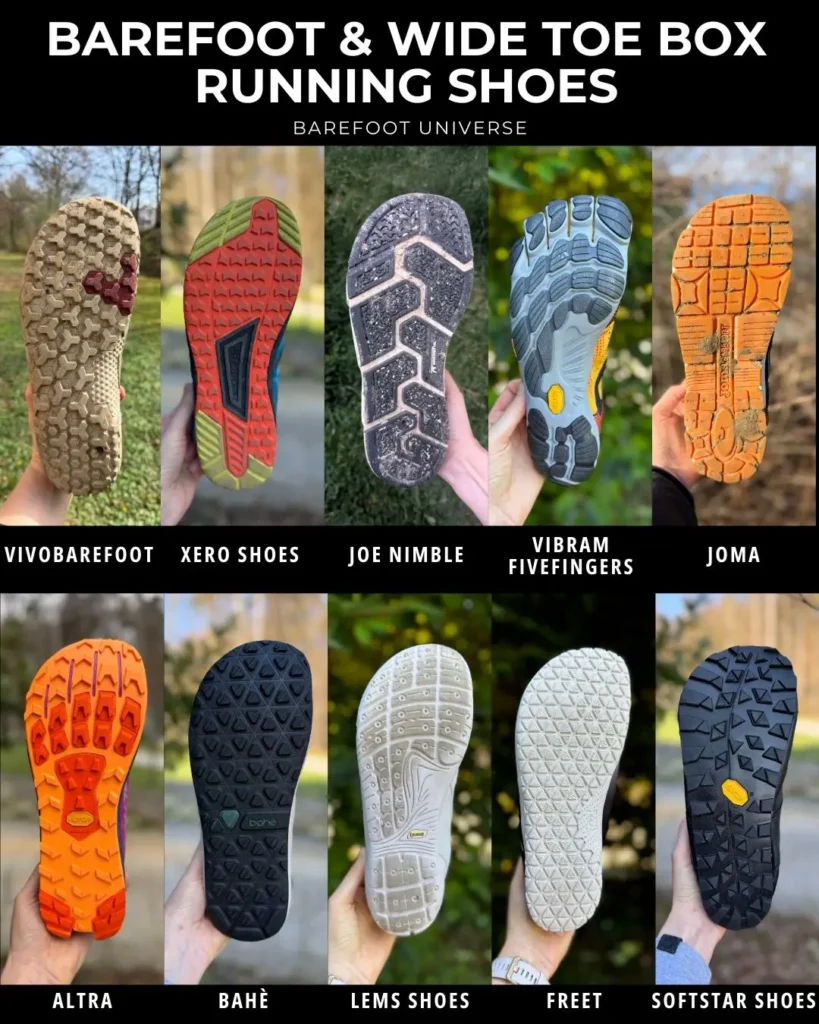
The collage below shows a visual comparison of the toe box shapes of the running shoes featured in this guide. The models are roughly arranged by width, from narrower to wider shapes. Use it as a quick reference to see how different barefoot and wide toe box running shoes compare at a glance.
FAQ: BAREFOOT RUNNING SHOES
Are barefoot running shoes good for running?
Barefoot running shoes can work very well for running because they allow your feet to move more naturally. With a wide toe box, flexible sole, and zero-drop design, they give your toes space to spread and encourage a more natural stride.
However, the key factor is whether your body is ready for minimalist footwear. If you are new to barefoot shoes, it’s important to transition gradually and build foot strength before running long distances in very thin soles.
What is the difference between barefoot running shoes and wide toe box running shoes?
Barefoot running shoes are designed to be highly minimalist. They typically have a thin and flexible sole, zero drop from heel to toe, and no arch support so the foot can move naturally.
Wide toe box running shoes also give your toes more space, but they usually include thicker cushioning and sometimes a small heel rise. This makes them a good option for runners who want foot-shaped shoes with more protection from impact.
Are barefoot running shoes good for long-distance running?
Some runners successfully use barefoot running shoes for long distances, especially once their feet are strong and adapted to minimalist footwear. Others prefer models with slightly thicker soles for longer runs or harder surfaces.
The best choice depends on your running technique, terrain, and how well your body has adapted to running in minimalist shoes.
Do barefoot running shoes cause injuries?
Barefoot running shoes themselves do not cause injuries. Problems usually occur when runners switch to very minimalist shoes too quickly without giving their body time to adapt.
Because barefoot shoes have thinner soles and less cushioning than traditional running shoes, your feet and lower legs take on a greater role in absorbing impact. If your body is not moving in good alignment or your feet are not strong enough yet, some of those forces can be transferred to joints and tissues that were not meant to handle them.
That’s why transitioning gradually and working on overall body alignment, running technique, and foot strength is important.
If you have movement compensations, past injuries, signs of overuse, or carry extra body weight, it’s especially important to progress carefully. In these cases, it can also be wise to consult a qualified professional or doctor. When the body moves well and adapts step by step, many runners use barefoot running shoes successfully without issues.
What are the best barefoot running shoes?
The best barefoot running shoes are lightweight, flexible, and allow your feet to move naturally. Key features to look for include a wide toe box, zero-drop sole, flexible construction, and no arch support.
Some of the most popular options include brands like Vibram FiveFingers, Xero Shoes, and Freet. The best choice for you will depend on your foot shape, running terrain, and how minimalist you want your running shoe to be.
Final Thoughts: Finding the Right Barefoot Running Shoe
Running in barefoot shoes can feel surprisingly natural once your body adapts. For many runners, it’s the first time their feet actually get to move, stabilize, and respond to the ground the way they’re meant to.
At the same time, most of us didn’t grow up using our feet this way. Years in narrow and heavily cushioned shoes change how our body moves, so the transition back to minimalist footwear should happen gradually.
Use this guide as a starting point to find a model that fits your feet well and supports the way you like to run.