




Best Barefoot Work Boots for Real Jobs (Wide Toe Box & Safety Picks)

Affiliate disclaimer

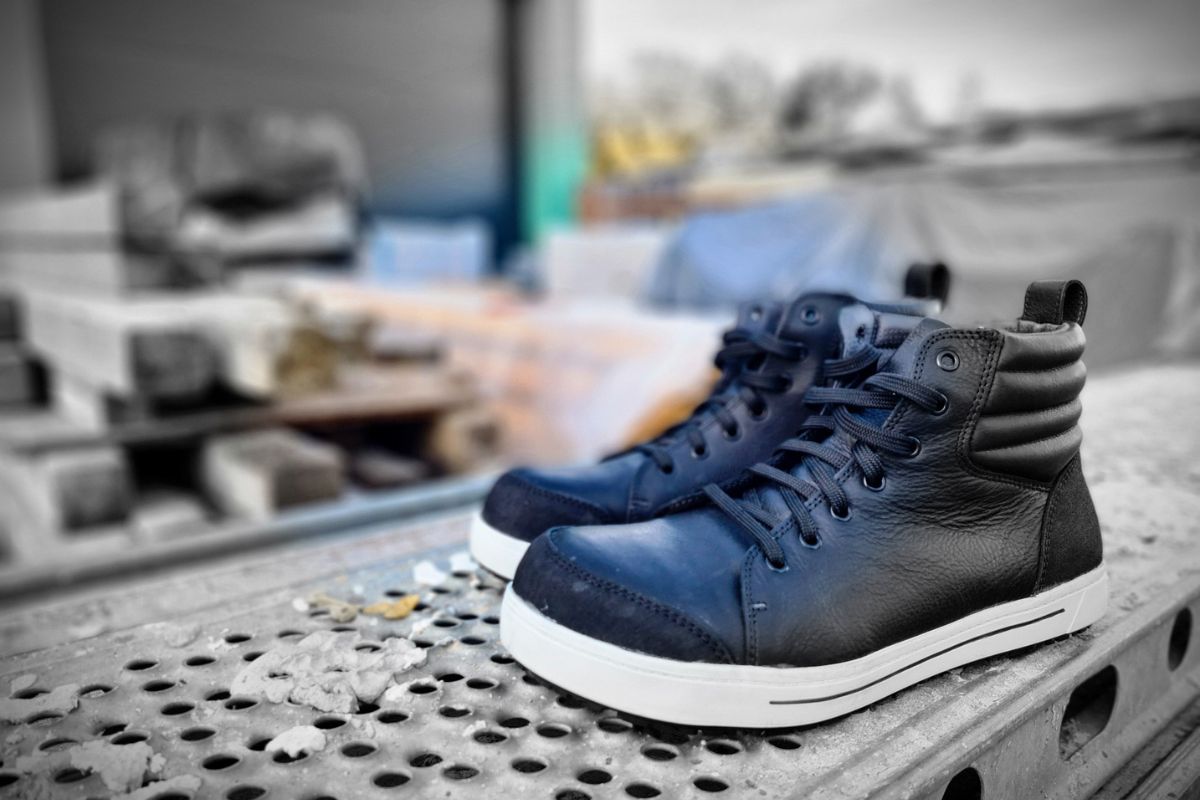
Traditional work boots are built for protection, but they’re often stiff, heavy, and surprisingly narrow at the toes. I know that feeling well from my years working as a civil engineer. Wearing steel toe work boots for several hours a day was often painful for me, especially around the toes.
That’s why we went looking for the best barefoot work boots and wide toe box work boots that give your feet more room without ignoring the demands of real work.
We don’t just compare specs. My husband and our friend Simon, both civil engineers, have helped us test work boots on actual building sites, including models worn regularly for work. Some models have also been tested by my father-in-law on his farm, where boots have to handle mud, wet ground, and long days outdoors.

Some of the boots in this guide are certified safety boots with protective toe caps, while others are better suited to farming, DIY, workshops, and jobs where safety certification isn’t required.
Here are the options that stood out most, along with what to know about fit, toe space, flexibility, and where each one makes the most sense.
Update (September 2026): This guide has been updated with new safety shoe brands, including BAAK and Gaucho Ninja, plus refreshed fit notes, more first-hand testing details, and clearer comparisons between safety-rated and non-safety work boots.
First, Check the Safety Certification Your Job Requires
Not every job requires the same type of work boot. If you work on a construction site or in another environment with specific safety requirements, you may need certified footwear with features such as a protective toe cap and puncture-resistant sole.
In Europe, safety footwear is certified under EN ISO 20345, but not every shoe certified to this standard has the same safety class. For example, if your employer requires S3 or S3S footwear, the shoe must carry that specific classification. In the US, ASTM F2413 is a separate standard, so always check the exact requirements for your workplace.
This is also where finding a truly barefoot option gets harder. Protective toe caps, puncture-resistant layers, and other safety features naturally add structure and weight, so even the most foot-shaped options won’t feel as soft or flexible as regular barefoot shoes.
If certified safety footwear isn’t required, you have much more choice. For farming, workshops, DIY, and other lower-risk work, you can choose more minimalist boots with wider toe boxes, lighter soles, and greater flexibility.
| Model | EU certification | US certification | What to know |
|---|---|---|---|
| BAAK Phoenix / Pegasus | EN ISO 20345:2024, S3S FO HRO SR ESD | — | Meets S3S requirements |
| Birkenstock QS500 / QS700 | EN ISO 20345:2022, S3S SR FO | — | Meets S3S requirements |
| Gaucho Ninja Sneaky Ninjas 2.0 | EN ISO 20345:2022+A1:2024, SB A PS FO SR HRO | ASTM F2413-24 I/C PR SD10 SRO | EN-certified, but not S3/S3S |
| Gaucho Ninja Carpenter | EN ISO 20345:2022, SB A PS FO SR | ASTM F2413-24 I/C PR SD10 SRO | EN-certified, but not S3/S3S |
| Carets Determination | — | ASTM F2413-18 + ASTM F3445-21 | US-certified, not EN ISO 20345 |
| Lems / Freet / VIVO | — | — | ❌ Not safety footwear |
Certified Wide Toe Box Work Boots With Protective Toe Cap
BAAK Barefoot Work Shoes


Best for: Construction and other jobs requiring certified safety footwear, especially if you want a wider, lighter, and more flexible alternative to traditional safety shoes.
Safety certification: EN ISO 20345, S3S FO HRO SR ESD.
Why We Like It: Probably the best balance of toe space, flexibility, low weight, and serious safety protection we’ve found so far. For Simon, they’ve become the clear favorite for everyday construction work.
BAAK is currently Simon’s favorite wide toe box safety shoe for building sites. He wore Birkenstock safety shoes before switching to BAAK, but prefers these because they feel noticeably lighter and more flexible while still providing the protection required for demanding work environments.
I tested them first, but Simon has now worn them much more extensively, including more than a year of almost daily use on construction sites. Of all the safety boots with a protective toe cap we’ve tried, BAAK has one of the roomiest toe boxes. They still aren’t completely foot-shaped, though. The toe cap tapers toward the front rather than following the full natural width of the toes.
According to BAAK, this shape was a compromise needed to meet strict European safety requirements without making the protective toe cap thicker and heavier. For me, the width itself was generous enough. However, because I chose a little more space in front of my toes and have a lower-volume foot, I didn’t fill the upper particularly well. The material folded over the forefoot and became uncomfortable after a while. Simon’s feet are slightly fuller, and he hasn’t had that issue.
Sizing & Fit: Best for medium-width feet with average or higher volume. Lower-volume feet may notice excess material over the forefoot, especially if choosing extra length.
Birkenstock QS700 and QS500 Steel-Toe Work Boots


Best for: Construction, manufacturing, warehousing, mining, and more.
Safety certification: EN ISO 20345:2022, S3S SR FO. Current QS500 and QS700 models are S3S-certified.
Why We Like It: A genuinely foot-shaped safety shoe with a clean, modern look and serious protective features. It’s especially good for narrower feet that still need proper toe space, although it feels heavier and stiffer than BAAK.
Before switching to BAAK, Simon wore Birkenstock safety shoes for work on building sites. They were one of the better options we had found because, unlike most traditional safety footwear, the QS500 and QS700 have a genuinely foot-shaped toe box with plenty of space for the toes.
They’re also surprisingly modern-looking for safety footwear. The QS700 is the taller boot version, while the QS500 sits lower around the ankle. If you don’t need the extra ankle coverage, the QS500 may feel less bulky, since the QS700 can feel quite stiff and heavy around the ankle.
Compared with BAAK, Birkenstock feels noticeably heavier and the sole is stiffer. The included insole also adds to that feeling. It is fairly firm and has noticeable arch support, so if you prefer a flatter and more flexible feel, swapping it for a thinner insole can make a big difference. Simon liked the Birkenstocks, but after trying BAAK, he preferred the lighter and more flexible feel for long days on construction sites.
The QS models include safety features such as a steel toe cap, penetration-resistant sole, slip resistance, heel energy absorption, antistatic protection, and resistance to oil and petrol. They are also available in leather and microfiber versions.
Sizing & Fit: These work best for narrower to medium-width feet. The toe box is fully foot-shaped, but the overall fit is not especially wide or high-volume. I tested size 43 with feet measuring 26.3 × 10 cm, and the internal length was about 28 cm. I prefer leaving a little more room in front of the toes, especially with a rigid steel toe cap, but very wide feet may still find these restrictive.
Carets Determination Safety Boots


Best for: US workplaces requiring ASTM-certified safety footwear, including construction, manufacturing, and warehousing.
Safety certification: US ASTM F2413-18 for impact, compression, electrical hazard and puncture resistance, plus ASTM F3445-21 slip resistance. Not EN ISO 20345 / S3-certified for EU workplaces.
Why We Like It: One of the most foot-shaped safety boots we’ve tested. The toe box is genuinely roomy, the sole is zero drop, and you still get the protective features needed for demanding work environments.
The Carets Determination is one of the few safety boots we’ve tried that combines a steel toe cap with a genuinely foot-shaped toe box. Unlike many safety shoes that still taper toward the front, Carets follows the natural shape of the foot much more closely and gives the toes plenty of room to spread.
I tested them for fit and comfort, and my husband also wore them on building sites, so we were able to see how they felt both on foot and in real work conditions.
Another feature I really like is the zero-drop sole with an integrated ladder groove. Your foot stays flat inside the boot, but the outsole still provides the functionality of a traditional work-boot heel when standing on ladders. They also have a water-resistant leather upper, slip-resistant outsole, large pull tab, speed hooks, and adjustable lacing.
These are still proper safety boots, so they feel heavier and more structured than regular barefoot boots. That is noticeable when you first put them on, but it comes with the steel toe cap and protective construction. They are certified in accordance with ASTM F2413-18, ASTM F3445-21, and ASTM D471.
Sizing & Fit: I tested size 43 with feet measuring 26.3 × 10 cm. They gave me plenty of room around the toes and worked well for my medium-width feet. If you like more space in front of your toes or plan to wear thick work socks, check the internal measurements carefully when choosing your size.
Gaucho Ninja


Use BU10 for 10% discount
Best for: Anyone looking for a wider safety shoe with a more modern or less traditional work-boot design.
Safety certification: Certification varies by model. Sneaky Ninjas 2.0 are certified to EN ISO 20345:2022+A1:2024 SB A PS FO SR HRO and ASTM F2413-24 I/C PR SD10 SRO. The Carpenter is EN ISO 20345-certified as SB A PS FO SR. These are certified safety shoes, but they are not S3/S3S-certified.
Why We Like It: One of the more stylish and varied barefoot-style safety ranges we’ve seen, with options ranging from sneakers to Chelsea boots. We’re including them as a brand to consider rather than a tested recommendation.
Gaucho Ninja is one of the more interesting brands we’ve come across for barefoot-style safety footwear. They offer several different designs, including safety trainers, lace-up work boots, and Chelsea-style safety boots, with some models labeled X-Wide.
What makes them stand out is the styling. Some of their safety shoes look much more like everyday sneakers or casual boots than typical work footwear, which is a nice option if you want safety shoes that feel a little less industrial. The downside is the price, which is higher than many of the other options in this guide.
We haven’t tested Gaucho Ninja safety shoes ourselves yet, so we can’t comment on their real-life fit, flexibility, or long-term comfort. They do offer models with protective toe caps, but if your workplace requires a specific safety certification, make sure to check the certification of the exact model before buying.
Sizing & Fit: Some models are offered in an X-Wide fit, but since we haven’t tested them, we can’t yet compare their width or volume directly with BAAK, Carets, or Birkenstock.
Wide Toe Box Work Boots Without Steel Toe Protection
Lems Boulder Boots

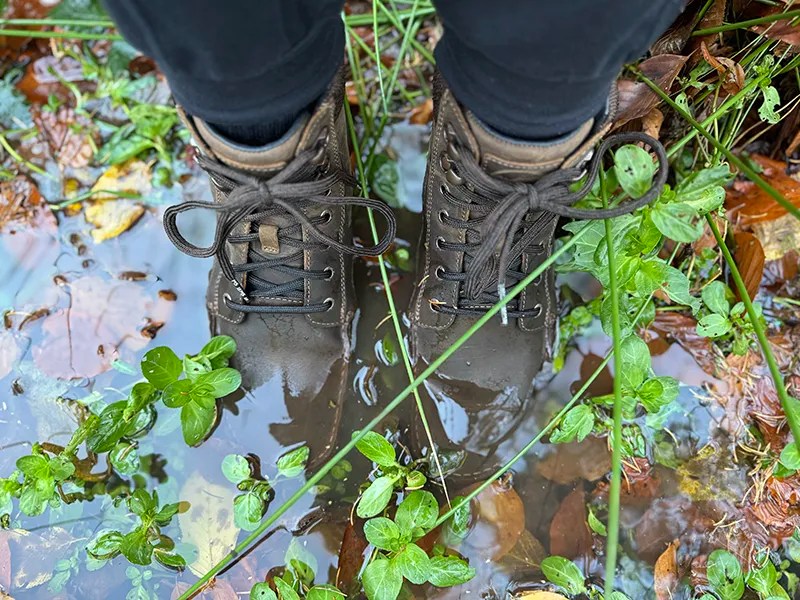
Use BU10 for 10% off at Lems EU
Best for: Farming, agricultural work, gardening, forestry, truck driving, at-home projects, and other jobs that don’t require certified safety footwear.
Why We Like It: A comfortable, lightweight work boot for jobs that don’t require safety certification. The foot-shaped toe box and thicker zero-drop sole make it a nice middle ground between a very minimal barefoot boot and a traditional heavy work boot.
The Lems Boulder Boots are a good option when you want a wide toe box and more natural fit but don’t need a steel toe cap or certified safety protection. They feel much lighter and less restrictive than traditional work boots, which can make a big difference when you’re wearing them for hours.
There are several Boulder Boot versions, including waterproof models and the Boulder Boot Grip Waterproof with a more slip-resistant outsole. The material around the ankle can feel a little stiff at first, but it softens with wear.
The zero-drop sole is thicker than what you’ll find on more minimalist barefoot boots. You lose some ground feel, but for work use that can actually be an advantage, giving you more separation from cold ground, rough surfaces, and sharp objects.
Sizing & Fit: Lems builds the Boulder Boot on its Wide last. It has a foot-shaped toe box and works best for medium-wide feet, but it isn’t one of Lems’ widest shapes. I wear US M10.5 with feet measuring 26.3 × 10 cm. If you need extra width or want to wear thicker work socks, sizing up by half to a full size can give you more room.
Freet Outdoor Boots


Use code BU_FREET for 10% discount
Best for: Farming, gardening, muddy outdoor work, and other jobs where certified safety footwear isn’t required.
Why We Like It: One of our favorite brands for muddy outdoor work. Freet gives you a genuine barefoot feel, good flexibility, and enough underfoot protection for jobs where you still want to feel connected to the ground.
We’re all big fans of Freet for outdoor work. When I know I’ll be dealing with mud, wet grass, or messy conditions, Freet is one of the first brands I think of. They don’t make safety boots with a steel toe cap, but they have several models that work really well for demanding outdoor use.
Models like the Bootee and Mudee still feel much more like true barefoot boots than traditional work footwear. The soles are flexible and give you plenty of ground feel, while the insoles add just enough extra protection to make rough or colder ground more comfortable. They’re still among the most barefoot-feeling options in this guide.
My father-in-law has also worn Freet for farm work, which is exactly the kind of use where we think they make the most sense. They give you the flexibility and natural feel of barefoot shoes without feeling too delicate for muddy everyday jobs.
Sizing & Fit: Freet generally works best for medium and wide feet, depending on the model. The fit can vary between styles, so it’s worth checking the individual size chart if you’re between sizes or plan to wear thicker socks.
VIVOBAREFOOT Tracker and Tracker Forest


Use BU_15 for 15% discount
Best for: Outdoor work, farm chores, gardening, landscaping, forestry, and other jobs where certified toe protection isn’t required.
Why We Like It: One of the best choices here if you want a true barefoot feel. The thin, flexible sole gives you more ground feedback than most work boots on this list, while the durable leather upper still makes them practical for messy outdoor jobs.
The VIVOBAREFOOT Tracker models are some of the most barefoot-feeling boots in this guide. Unlike many wide toe box work boots that still use thicker, more protective soles, VIVO keeps the sole relatively thin and flexible, so you get noticeably more ground feel.
They’re made from high-quality leather and work especially well for muddy outdoor jobs because the uppers are easy to wipe and clean afterward. They still feel like proper outdoor boots, but without the heavy, rigid feel you get from traditional work footwear.
The main thing to keep in mind is that these are barefoot boots, not safety boots. There’s no steel toe cap or certified protection, so they make more sense for farm work, landscaping, gardening, forestry, or general outdoor work where that level of protection isn’t required.
Sizing & Fit: VIVO works best for narrower to medium-width feet. Men’s sizes tend to fit a little wider than women’s, so wider feet may have more luck there. If your feet are very wide, some of the other options in this guide will give you more room.
Barefoot Work Boots Are Finally Getting Better
Finding barefoot work boots with a wide toe box is still harder than it should be, especially when safety certification is required. But there are now more genuinely foot-friendly options for construction, farming, outdoor work, and everyday jobs.
We’ll keep updating this guide as new safety shoes and work boots become available.

I work doing home repairs. I use barefoot shoes buy I bend a lot and my big toe is coming through the mesh upper. I dontvwan th boots but shoes but not with a mesh upper. It has to be like barefoot cuz of my toed. Anybideas?
Hi Fred!
I totally get the issue. Mesh uppers can wear out faster with repeated bending, especially for things like home repairs.
I’d look for barefoot shoes with a sturdier upper, such as leather, vegan leather, or another non-mesh material. They should hold up better while still giving you the foot-shaped fit and barefoot feel you’re looking for.
If you tell us a bit more about your foot width and shape, we can suggest a few options.